top of page

Updated: Sep 9

Although enduring embankments of marine-adapted plant life stretch down inland corridors, the most frequented shores of Sydney Harbour are now variously articulated with stone, concrete fortifications and grey dock timber stakes. In Circular Quay – an international passenger terminal and tourist precinct - the waters of Port Jackson do battle with the driven shafts, blades and bellies of harbour vessels. I lean on the chipped green railing at Commissioner’s Steps, it’s raining, and the dock workers are smoking, restless to send off the lately moored cruise ship with passengers waving from the upper deck.


Over the hours ship spotters have accrued under two young, bedded Morton Bay Figs, crossed legged with books, umbrellas and cameras. “When’s she leaving?” they ask neon-vestees “Is she on time? When will she go?”. The interrogated shake heads, open and close gates. I turn my lens to the waters, unexpectantly variable in colouring on an overcast day. Carried into the port by winds, currents, tides and wakes, the broad waters have narrowed to the tight angulation of the quay, and here the body hoards intermittent patches of leaves, oils and plastics, leeched, plucked, or delivered by the wind or by the hand of neglect.


When photographers embark on spontaneous trips, themes often emerge organically. While reviewing captured narratives— documented objects, places, and routes — patterns tell a perspective shaped by the journey. I've just come back from a few days around Circular Quay in Sydney, Australia. But this time, before I unpacked this visit's worth of photographs from my weary SD card, I already anticipated a particular thematic.


A photograph taken by Australian Artist Megan Kennedy of maritime rope attached to a cruise ship in Circular Key as a work of art

On the second day of my expedition, I looked out the room window to the bridge of the Crown Princess towering over the architecture of the Rocks, a soundless overnight arrival. I got dressed, packed, harnessed my camera and walked down through the narrowed sandstone passages to see it, capacity: 3,080 passengers and 1,200 crew, 290m long, 113,561 tonnage. A friendly security guard told me that she was merely a ‘medium’ cruise ship in scale.


I come from a nautical family. My Dad pilots rescue vessels. My Mum boarded harbor ships and maintains the radio comms while my Dad is at sea. My brother has charted seas and lakes. My uncle makes steam-powered vessels. But I fear the sea, never been too far out. Instead, I admire giants such as the Crown Princess like an Antonov 124 of the sea, from a distance and in awe.


A photograph taken by Australian Artist Megan Kennedy of maritime rope attached to a cruise ship in Circular Key as a work of art

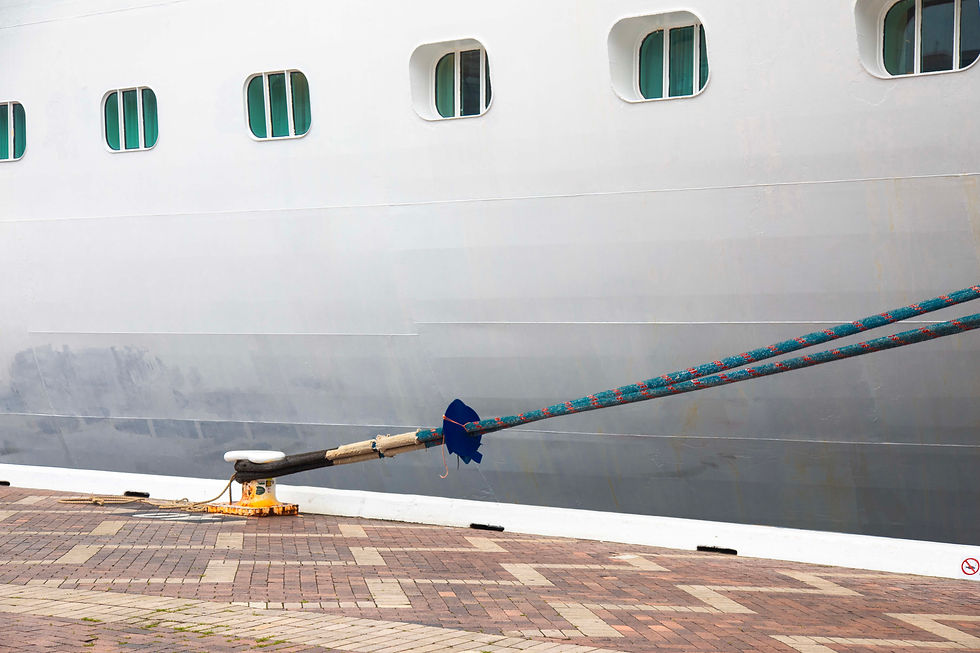
Walking by the dock, a detail flagged my eye. Proportionately and intricately braided thicknesses of mooring lines trailed from the ship’s bow and looped around several bollards along the pier. I was reminded, textiles and maritime history go hand in hand. Ancient sailcloth made of woven fibres harnessed rapid wind-powered transportation. But these modern braided, cuffed and collaged lines captivated me the most. They almost looked improvised, but seafaring demands considered and enduring structural architecture. Returning to port, these modest lines are an ancient meeting of construction and utility, fabricated to withstand the elemental forces – winds, waves, tides. They’re beautiful, worked, roughed and practiced, quiet and dynamic, heavy but elastic enough to absorb shock, a vital safeguard.


A photograph taken by Australian Artist Megan Kennedy of maritime rope attached to a cruise ship in Circular Key as a work of art

Later into the rainy day the moorings were manually released by landside dock workers and wound back mechanically into the hull, knots intact. As the ship shrunk away into the harbor, guided by a red tug with a protective white sheet over the bow, I reflected on material association. From a group of fibres or strands twisted together into a larger and stronger form of itself, many relationships can be drawn: protection, strength, ingenuity, history, requirement, restriction, links, bonds and cohesive physical and mental processes.


A contemporary artwork at the Museum of Contemporary Art in Sydney by Kate Newby titled Hours in Wind (2024) photographed by Megan Kennedy

The next day I visited the Sydney Museum of Contemporary Art, a little way back from where the Crown Princess was moored. In her place another ship, the Queen Elizabeth – 2081 passengers and 911 crew, 293m long, 90,900 tonnage. Weaving through the gallery works, I found Kate Newby’s Hours in Wind (2024) on the open terrace. She too was drawn by the deceptively ordinary shipping rope. Constructed from salvaged moorings, glass and bronze, Hours in the Wind was created for the purpose of meeting and activating the conditions of the harbor, including shifting light and weather patterns. Newby is known for her site-responsive work and the interplay of shadow and material, rocking gently in the sea breeze, felt like a continuation of the captivation I’d experienced at the dock. The sight affirmed how much these threads—of protection, strength, and ingenuity—resonate across personal and artistic exploration.


A contemporary artwork at the Museum of Contemporary Art in Sydney by Kate Newby titled Hours in Wind (2024) photographed by Megan Kennedy

Over Autumn and Winter we have had recent and repetitive flooding at our home, and pooled water has leaked beneath the tile, requiring the need for comprehensive replacement in a dryer season. It’s spring now, and last week a guy with a small jack-hammer systematically fractured the pale ceramic surface, dumping the freshly pointed chips in several plastic baskets for removal. In the afternoon I surveyed the day’s progress.


With the tile eliminated, the raked masonry gripped nothing above, revealing a now unreciprocated material relationship - for a long time the cement-based adhesive had anchored the tiles while the stabilized tiles themselves protected and preserved the underlying structure. But now, as I looked, I felt a practical, architectural absence. There was necessary repair in progress, but also revelation, like looking at the innards of a stopped watch. And when I started to document the site with my camera, I was reminded of dermatoglyphics.


I felt like I was documenting some liminal archaeological site, some form of identity beneath - gesture, historical and architectural development, time, form and environment. And all this mapped and exposed for so little time. The next day my dermatoglyphs were poured over with a fresh layer of remedial concrete and sealed with a new, greyer field of tile. I was glad to have taken photographs when I did.


bottom of page